Calculate Recall Condition Positive Negative
Calculate Recall Condition Positive Negative. A false positive is when a normal file is thought. Fdr = fp / (fp + tp) false negative rate:
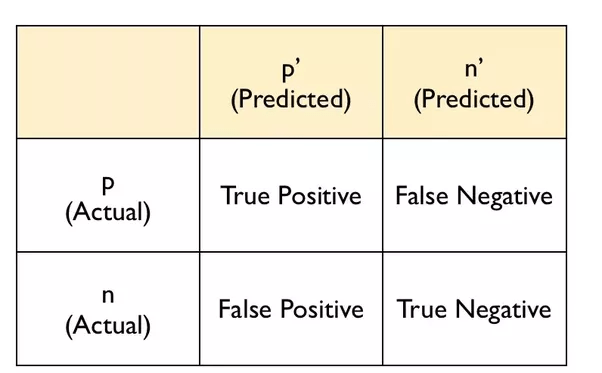
While true or false judges this output whether correct or incorrect. Calculating precision and recall is actually quite easy. A/(a + b) × 100 10/50 × 100 = 20%;
A False Positive Is When A Normal File Is Thought.
Positive predictive value (precision) ppv = tp / (tp + fp) negative predictive value: F1 score = 2*(recall * precision) / (recall + precision) specificity. F1 score = 2 * (precision * recall)/ (precision + recall) f1 score is considered a better indicator of the classifier’s performance than the regular accuracy measure.
In This Educational Review, We Will Simply Define And Calculate The Accuracy, Sensitivity, And Specificity Of A Hypothetical Test.
D/(d + c) × 100 Calculating precision and recall is actually quite easy. For a clinician, however, the important fact is among the people who test positive, only 20% actually have the disease.
A/(A + B) × 100 10/50 × 100 = 20%;
Tpr = 1 means we predict correctly all the positives. Compute precision, recall, f1 score for each epoch. There are four results provided by the calculator:
False (Dog) False Negative = 50 Cost Per Occurrence = $5,000 50 / 5000 = 1%:
The matrix (table) shows us the number of. A false positive is when ordinary items such as keys or coins get mistaken for weapons (machine goes beep); False positive = 200 cost per occurrence = $2,000 200 / 5000 = 4%:
Fpr = Fp / (Fp + Tn) False Discovery Rate:
Sensitivity = true positive / (true positive + false negative) x 100. Keras allows us to access the model during training via a callback function, on which we can extend to compute the desired quantities. A confusion matrix is a popular representation of the performance of classification models.


Comments
Post a Comment